TL;DR:
- Iceland’s national parks are uniquely situated on active volcanoes, tectonic plates, and vast glaciers, offering extraordinary geological and cultural experiences. Guided tours are essential for safely accessing remote areas, glacier activities, and highland routes that self-drivers cannot confidently or safely reach. Combining self-driving accessible highlights with expert-guided excursions provides the best balance of flexibility, safety, and in-depth understanding for visitors.
Iceland’s national parks aren’t like the ones you’ve visited elsewhere. They sit on active volcanoes, straddle tectonic plates, and swallow glaciers the size of entire European countries. Most first-time visitors assume a rental car, a good map app, and a few clear days are all they need. That’s partly true — for the basics. But the waterfalls, ice caves, lava fields, and highland routes that define Iceland’s most jaw-dropping experiences often sit well beyond what a solo driver can safely reach or fully understand without expert guidance. Guided national park tours change that equation entirely.
Table of Contents
- What makes Iceland’s national parks unique?
- Touring vs. self-driving: Which is best for Iceland’s parks?
- Key benefits of guided national park tours
- How to choose the right Iceland national park tour
- Why tours open doors most travelers miss
- Discover Iceland’s parks the easy way with TripIceland
- Frequently asked questions
Key Takeaways
| Point | Details |
|---|---|
| Tour unlocks access | Guided tours make it easy and safe to experience remote, adventurous regions of Iceland’s national parks. |
| Local expertise matters | Skilled guides provide safety, cultural context, and logistical know-how that solo visits can’t match. |
| Not all parks require a tour | Famous sites like Þingvellir can be self-driven, but technical areas strongly benefit from tours. |
| Plan regionally | Think in terms of park regions and travel seasons to maximize your experience and avoid surprises. |
| Tours suit all travelers | Whether you’re seeking adventure or just want efficient sightseeing, there’s a national park tour for every style. |
What makes Iceland’s national parks unique?
Iceland packs an extraordinary range of geological drama into a small landmass. Its three national parks — Þingvellir, Vatnajökull, and Snæfellsjökull — each tell a distinct story, and together they represent some of the most geologically active and culturally significant landscapes on the planet.
Þingvellir National Park sits directly on the Mid-Atlantic Ridge, where the North American and Eurasian tectonic plates pull apart at roughly 2 centimeters per year. This is the only place on Earth where you can snorkel or dive between two continental plates. Beyond the geology, Þingvellir served as the seat of the Alþingi, one of the world’s oldest parliaments, founded in 930 AD. That combination of geological wonder and living history makes it one of Iceland’s most layered destinations.
Vatnajökull National Park is a different beast altogether. It covers roughly 14% of Iceland’s total land area and shelters Europe’s largest glacier by volume. Beneath that ice lie several active volcanoes, including Grímsvötn, which erupted as recently as 2011. The park’s stunning landscapes in Iceland include the Skaftafell nature reserve, the Jökulsárlón glacier lagoon, and dramatic canyons carved by glacial floods. According to a detailed review of the park, Iceland’s national parks concentrate standout geology and nature experiences — rift valleys, glaciers, waterfalls, and volcanic landscapes — into day-accessible and guided itineraries that reward even short trip windows.
Snæfellsjökull National Park caps the Snæfellsnes Peninsula with a glacier-topped stratovolcano that Jules Verne used as his fictional gateway to the center of the Earth. Its lava fields, sea cliffs, and black sand beaches feel remote despite being reachable in under two hours from Reykjavik.
Here’s a quick look at how Iceland’s national parks compare across key visitor factors:
| Park | Size | Top Feature | Best Access Season | Guided Tour Recommended |
|---|---|---|---|---|
| Þingvellir | 237 km² | Tectonic rift, Alþingi site | Year-round | Optional for basics, yes for diving |
| Vatnajökull | 14,141 km² | Europe’s largest glacier | Year-round (varies by sector) | Strongly yes |
| Snæfellsjökull | 170 km² | Glacier volcano, lava fields | May to October (peak) | Recommended |
Key features shared across all three parks:
- Active volcanic geology visible at surface level
- UNESCO World Heritage status (Þingvellir) or strong candidacy
- Multiple ecosystems within a single park boundary
- Significant seasonal variation affecting access and safety
- Cultural or scientific narratives that reward expert explanation
“Iceland’s national parks are worth visiting because they compress what would take weeks to see elsewhere into manageable, guided-activity itineraries. The geology alone tells a story that most travelers only scratch the surface of without a knowledgeable guide.”
Touring vs. self-driving: Which is best for Iceland’s parks?
Understanding each park’s unique features sets up an important question: how should you explore them — on your own, or with a guide?
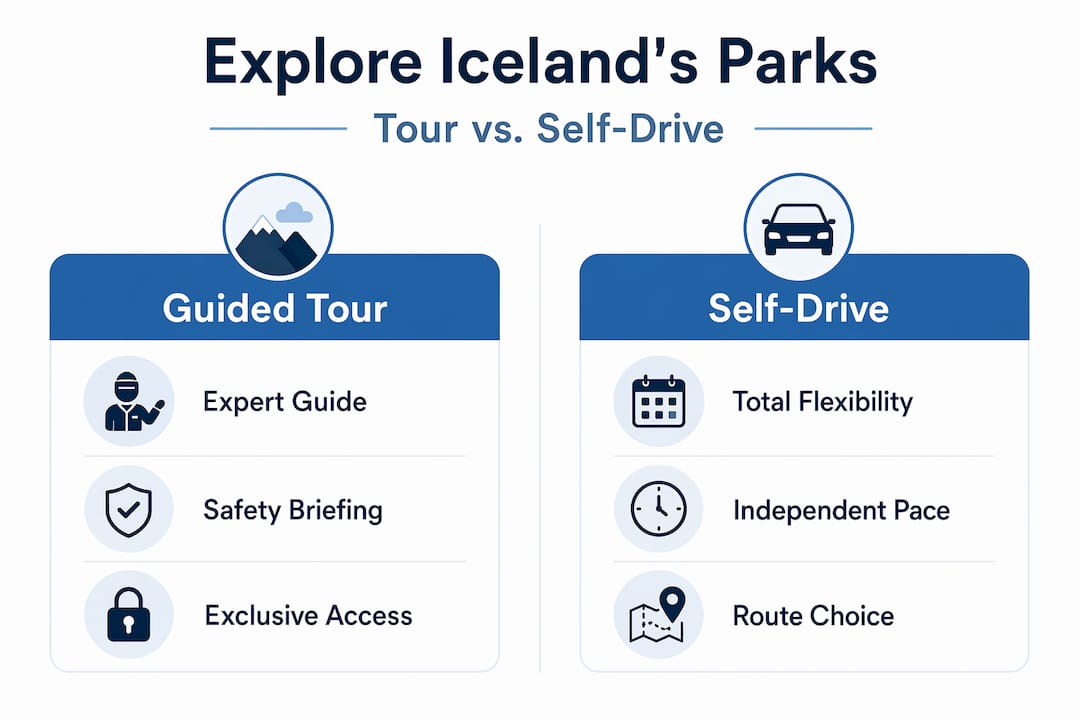
The honest answer is that it depends. Self-driving works well for confident drivers who want to move at their own pace and stick to paved, accessible areas. Iceland’s Ring Road connects many of the major park entry points, and rental cars are widely available. For destinations like Þingvellir or the southern edge of Vatnajökull, a self-driver with solid navigation and weather awareness can have a great experience.
But here’s where the comparison shifts significantly:
| Factor | Self-Drive | Guided Tour |
|---|---|---|
| Flexibility | High (set your own schedule) | Moderate (fixed itineraries, but structured) |
| Safety on glacier terrain | Risky without experience | Managed by certified guides |
| Equipment access | Must rent or bring your own | Typically included |
| Local expertise | Limited | Extensive, on-the-spot explanations |
| Highland road access | Requires F-road capable 4×4 | Handled by tour operators |
| Weather adaptability | You decide if conditions are safe | Guide makes that call professionally |
| Cost efficiency for groups | Lower per person | Higher individual cost, but value-packed |
Guided glacier experiences inside Vatnajökull address critical technical safety and logistics. That means crampons, helmets, ice axes, route selection based on daily conditions, and certified guides who know when a route is safe and when it isn’t. Renting all that gear independently — and more importantly, making the right safety calls without experience — is where solo travel gets genuinely dangerous.
Here’s a practical decision framework for planning your Iceland park visits:
- Identify your park priorities before booking anything. Are you most drawn to geological history, adventure activities, or scenic photography?
- Assess your driving confidence in unpredictable conditions. Iceland’s weather can shift from sunshine to whiteout in under an hour.
- Check road classifications. F-roads (highland routes) are legally off-limits to standard rental vehicles and require a 4×4 with high clearance.
- Determine your activity goals. Glacier hikes, ice cave visits, and lava tube explorations almost always benefit from guided participation.
- Compare bus tours in Iceland against self-drive options for your specific dates and group size.
Pro Tip: If you’re traveling in winter, guided tours are even more critical. Road conditions change hourly, highland routes close without warning, and glacier ice caves are only accessible during the colder months with guides who know current conditions.
Consider bus services for national parks as a smarter middle ground: they offer the structure of a guided experience with group efficiency and the convenience of not worrying about driving at all.
Key benefits of guided national park tours
Choosing between touring and self-driving depends on context; here are major reasons why guided tours make a measurable difference for most travelers.
Time efficiency. Iceland’s parks are vast. Vatnajökull alone covers more than 14,000 square kilometers. Without a guide who knows exactly where to go and when, it’s easy to spend half a day getting to a single viewpoint. A well-planned tour itinerary compresses the best highlights into a structured day, hitting signature stops along the Ring Road while leaving time for guided glacier activities.
Safety management. Iceland’s interior is genuinely remote. Glacial rivers swell without warning, volcanic activity can shift access routes, and highland weather regularly surprises even experienced travelers. Guides carry emergency equipment, monitor real-time weather forecasts, and make route decisions based on current conditions, not optimism.
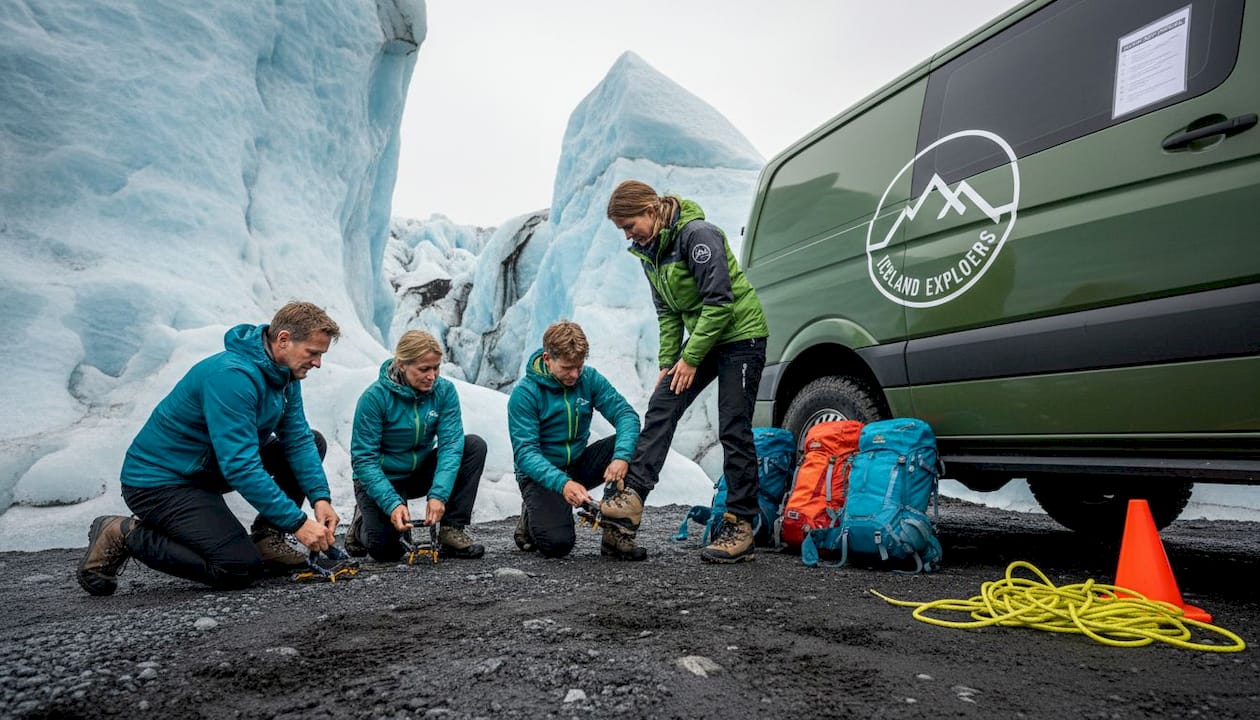
Exclusive access. Many of the most impressive parts of Iceland’s parks are only reachable with a 4×4 vehicle, specialized equipment, or a licensed operator. Road conditions and weather often constrain access on gravel and off-road routes to highland stops — tour operators manage this as an itinerary advantage, not an obstacle.
Educational depth. A glaciologist can explain why a specific glacier is retreating at a faster rate than its neighbors. A local historian can describe what the ancient Alþingi sessions actually looked like in a lava-field parliament. These are the layers of understanding that convert a beautiful view into a genuinely unforgettable moment.
Key benefits worth highlighting for first-time park visitors:
- Guides explain geological features in plain, engaging language
- Group safety briefings reduce accident risk on glacier terrain
- Tours often include stops at lesser-known sites alongside the main attractions
- Shared logistics (transportation, gear, permits) reduce individual planning burden
- Real-time weather rerouting keeps your day productive even when conditions shift
Pro Tip: Always ask your tour operator what percentage of their guides are certified by Icelandic authorities. Look for guides who hold SAR (Search and Rescue) certifications or glacier guide certifications from recognized Icelandic bodies.
Browse the best bus tours in Iceland to compare itineraries, group sizes, and activity types before committing to a package. A good guide to scenic bus tours will also help you identify routes that visit the lesser-photographed corners of each park.
How to choose the right Iceland national park tour
Once you know why guided tours are valuable, the next step is finding the approach that fits your exact travel style.
Iceland’s parks are diverse enough that a one-size-fits-all tour package rarely delivers the best experience. Matching your tour to your specific priorities makes a real difference. Planning around region-based itineraries for Vatnajökull is a strong approach: the southern sector around Skaftafell offers the easiest Ring Road access, while the northern and eastern sectors feel far more remote and require additional planning time. Building a weather buffer for glacier-focused days is especially important.
It’s also worth noting that Iceland’s national parks often blend seamlessly with nature reserves and protected areas, so itineraries typically anchor around a few signature stops and connect them with nearby attractions. This shapes how tours are structured: short guided stops at iconic sites plus longer guided add-ons for adventure activities.
Here’s a practical step-by-step approach to choosing your tour:
- List your non-negotiables. Glacier hike? Tectonic rift snorkel? Ice cave? Start with those and find tours that include them.
- Match the activity to your fitness level. Glacier walks range from easy 1-hour strolls to full-day summit hikes. Know which category fits your group.
- Check seasonal access. Ice caves at Vatnajökull are only accessible from November to March. Snæfellsjökull’s summit is best attempted in summer. Confirm availability before booking.
- Ask about gear inclusion. Tours that provide crampons, helmets, and waterproof layers eliminate the stress of packing or renting specialized equipment.
- Build in a weather buffer. Add at least one flexible day to your itinerary for glacier or highland activities. Iceland’s weather doesn’t negotiate.
- Read the national park travel handbook for region-specific details before finalizing your route.
If you want experiences away from the crowds, consider off the beaten path bus tours that prioritize lesser-visited park sectors and hidden geological features. These tours often yield the most memorable stories because the sites feel genuinely discovered rather than curated for mass tourism.
Pro Tip: For groups of four or more, a private guided tour often costs less per person than individual bookings while offering full itinerary customization. Compare group options before defaulting to a public tour.
Why tours open doors most travelers miss
Here’s a perspective most travel guides won’t share directly: going it alone in Iceland’s national parks isn’t adventurous. It’s often limiting.
This isn’t about being cautious or overly managed. It’s about what’s actually possible. The travelers who leave Iceland with the most extraordinary stories — who stood inside a glacier ice cave with walls glowing blue, who watched a subglacial river pour through a lava canyon nobody photographs, who heard a guide explain why a specific rock formation is evidence of a medieval volcanic eruption — those people almost never did it alone. They were with someone who knew where to go, when to go, and what it all meant.
Self-driving Þingvellir is perfectly straightforward, and if your only goal is to see the rift valley from the viewing platform, a rental car gets you there. The Golden Circle stops, including Þingvellir, are described as straightforward to self-drive, and the tour value there shifts to expertise and timing rather than access. But the moment you step off the Ring Road — onto ice, into a lava tube, up an F-road toward the highlands — the equation changes completely.
Expert-led bus tours don’t just move you between landmarks. They convert an itinerary into an education. The geological and cultural context that makes Iceland’s parks genuinely extraordinary is almost entirely invisible without someone who can read the landscape and explain what you’re looking at.
The most honest advice for first-time Iceland visitors: self-drive the accessible highlights you’re confident about, and invest in guided tours for everything that requires ice, altitude, highland roads, or genuine remoteness. That combination gives you flexibility where it matters and expertise where it’s essential.
Discover Iceland’s parks the easy way with TripIceland
Planning a national park visit in Iceland is exciting — but getting the logistics right takes real expertise. TripIceland specializes in exactly that.
Whether you’re a travel agent building a group itinerary, a corporate team planning an incentive trip, or an individual traveler looking for a seamless experience, TripIceland offers guided tours and day trips tailored to Iceland’s most compelling natural parks. Our range of buses and vehicles is built for Iceland’s roads — from comfortable coaches for Golden Circle routes to robust transport for highland excursions. Ready to start planning? Book your Icelandic park adventure and let us handle the logistics while you focus on the experience.
Frequently asked questions
Are guided tours necessary for all Icelandic national parks?
Not all parks require guided tours, but they are highly recommended for glacier hikes, highlands, and technical or safety-intensive activities. For accessible sites like the main Þingvellir viewing areas, self-driving is feasible, but glacier hike safety demands certified guides who manage gear, routes, and conditions.
Can I self-drive to Iceland’s most famous national parks?
Most marquee sites like Þingvellir are accessible by paved roads, but remote regions and highland routes require guided support for both safety and access. The Golden Circle’s main stops are straightforward to self-drive, though tour value increases significantly for timing-sensitive and higher-risk activities.
What equipment do tours provide for glacier experiences?
Tours typically supply crampons, helmets, and ice axes, along with expert safety briefings and certified guide leadership throughout the hike. This comprehensive approach to guided glacier logistics is exactly why most travelers opt for a structured tour rather than attempting glacier terrain independently.
How long should I plan to visit Vatnajökull National Park?
First-time visitors should plan at least 2 to 3 days to experience both glacier activities and the park’s top scenic highlights without feeling rushed. Adding an extra buffer day for weather-related rerouting is strongly advisable, especially for glacier-focused itineraries.
Recommended
- Experience Iceland’s Stunning Landscapes with TripIceland
- Uncovering Iceland’s Best-Kept Secret: The Ultimate Bus Tour Experience to Hidden Hot Springs
- Have You Heard About These Secret Spots? A Casual Guide to Scenic Bus Tours in Iceland
- A Journey Off the Beaten Path: Exploring Iceland’s Hidden Treasures on Scenic Bus Tours